Use Your Child’s 2026 Dental Benefits Before They Reset: A Vineland Parent’s Checklist

It’s mid-November, and only about seven weeks remain in 2026. Every winter, families tell us they meant to book a second checkup, finish a filling, or ask about sealants, and then December ran out. This checklist shows how to use dental benefits before end of year: what’s worth doing for your child before December 31, what to ask your insurance company, and how to put FSA dollars to work.
Why the End of the Year Matters for Your Child’s Dental Plan
Most dental plans set an annual maximum, the most the plan will pay for a covered child in one benefit year. Most plans also have a deductible, which you pay before certain services are covered.
On a calendar-year plan, both start over on January 1, and unused dollars generally don’t carry forward. Some employer plans use a different plan year, so confirm your dates first. Coverage percentages, age limits, and waiting periods vary by plan, so treat this as a typical pattern rather than a promise of coverage.
How to Use Dental Benefits Before End of Year: Your Before-December-31 Checklist
1. Check remaining benefits, deductible, and plan year
Log in to your member portal or call the number on your child’s insurance card. Ask:
- When does my child’s benefit year end?
- How much of the annual maximum is left?
- Has the deductible been met?
- How many cleanings, fluoride treatments, and X-rays has my child used this year?
- Are there age limits on sealants or fluoride?
If the answers are confusing, call us and we’ll help you make sense of them.
2. Book the exam and cleaning
The American Academy of Pediatric Dentistry recommends a first dental visit when the first tooth comes in, and no later than 12 months of age. After that, it recommends visits on a schedule based on your child’s cavity risk, commonly every six months. If your child has had only one visit this year, a second may still fit.
3. Fluoride
A professional fluoride treatment usually happens at the checkup. Many plans cover it only a set number of times a year and only up to a certain age, so ask about your child’s limits.
4. X-rays, if due
Plans typically limit how often X-rays are covered. If your child is due, the dentist decides at the visit which images are actually needed.
5. Sealants on permanent molars
Sealants coat the chewing surfaces of back teeth, where cavities often start. Plans commonly cover them on permanent molars up to an age cutoff, which makes a child whose six-year or twelve-year molars recently came in a strong candidate. Learn more about Dental Sealants for Kids.
6. Finish treatment that was already recommended
Was a filling or crown recommended at your child’s last visit? December can be a smart time to finish it, especially if you’ve already met this year’s deductible. Two things to know:
- Our dentist decides timing based on your child’s teeth, not the calendar.
- Many insurers date multi-step work, such as crowns, by the day it’s completed. Ask your plan how it treats work that spans two visits.
See Restorative for Kids and White Crowns for Kids.
7. Orthodontic evaluation
Orthodontic coverage works differently. Many plans pay toward braces from a separate lifetime maximum that doesn’t reset each year. An evaluation now helps you plan next year’s FSA election and benefits. Explore Early Start Orthodontics and Braces.
8. FSA balance and receipts
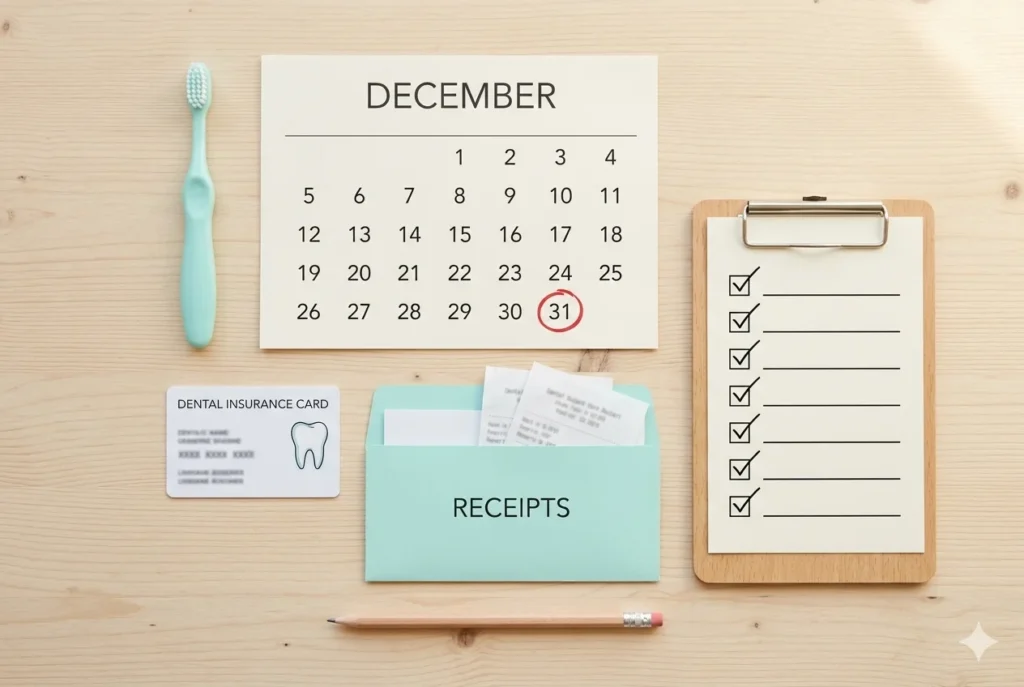
Check your health FSA balance and deadline. Save an itemized receipt from every dental visit, because your FSA administrator may ask for them.
Your 7-Week Countdown to December 31
| Week of | Vineland family calendar | What to do |
|---|---|---|
| Nov 16 | Regular school week | Check benefits and call to book |
| Nov 23 | Thanksgiving week: abbreviated day Nov 25, closed Nov 26–27 | Ask about break-day openings; confirm your FSA deadline. |
| Nov 30 | Regular school week | Exams, cleanings, fluoride, X-rays |
| Dec 7 | Regular school week | Sealants and fillings recommended at the checkup |
| Dec 14 | Regular school week | Final visits for treatment that takes more than one appointment |
| Dec 21 | Abbreviated day Dec 23; winter recess starts Dec 24 | Last-chance visits if available; submit FSA receipts |
| Dec 28 | Winter recess through Jan 1 | Calendar-year benefits reset Jan 1 |
School dates come from the Vineland Public Schools calendar.
What Resets January 1 vs. What Carries Over
| Benefit | What typically happens on a calendar-year plan |
|---|---|
| Annual dental maximum | Resets. Unused dollars are usually lost, though a few plans let you bank part of it |
| Deductible | Starts over |
| Limits on cleanings, fluoride, and X-rays | Start over. A skipped visit doesn’t double up next year |
| Orthodontic lifetime maximum | Usually does not reset |
| Health FSA (2026 money) | Forfeited, unless your employer offers a carryover of up to $680 or a grace period of up to 2½ months (never both) |
| HSA | Stays with you from year to year |
Using an FSA for Kids’ Dental Care: What Qualifies
A health FSA can pay for eligible dental care for your dependent children. IRS Publication 502 treats dental care that prevents or treats dental disease as a medical expense:
- Preventive care: cleanings, sealants, and fluoride treatments.
- Treatment: X-rays, fillings, braces, and extractions.
Toothbrushes and toothpaste don’t qualify, because the IRS treats them as personal expenses.
The 2026 numbers:
- Contribution limit: IRS Revenue Procedure 2025-32 sets the health FSA limit at $3,400 per employee for 2026.
- Use it or lose it: FSAs generally follow this rule. Under IRS Publication 969, an employer may soften it with one of two options, but never both:
- A grace period of up to 2½ months after the plan year ends. For a calendar-year plan, that runs through March 15, 2027.
- A carryover of up to $680.
- Ask HR which rule applies to you.
Braces tip: Plans handle orthodontic payments differently. Some FSA plans reimburse an upfront payment, while others reimburse as monthly payments are made. Check with your FSA administrator before you pay.
What Happens If Benefits Go Unused?
- The rest of your child’s annual maximum disappears.
- The deductible starts over in January.
- Missed checkups can’t be saved for next year.
- Small problems can grow. A cavity caught early is usually simpler to treat than one found after it starts to hurt.
- FSA dollars left after your plan’s deadline are forfeited.
No dental insurance? Ask about our In-House Savings Plan, or review our Financing & Insurance Solutions.
Booking Timing: Why Calling in November Beats Waiting
December is when every family remembers their benefits at the same time. Winter recess in Vineland runs December 24 through January 1, and break-day and after-school appointments go first. Calling now gives you more choice of times and leaves room for a follow-up visit, so you can use dental benefits before end of year.
A few tips:
- Have your child’s member ID ready when you call.
- Book siblings back-to-back.
- Ask whether a cancellation list is available.
FAQs
Q1. Do unused dental benefits roll over to next year?
A: Usually not. On calendar-year plans, the unused part of your child’s annual maximum typically expires December 31, and the deductible starts over. A few plans let you bank part of an unused maximum if you meet certain conditions, so check your plan documents.
Q2. Can I use my FSA for my child’s dental visits and braces?
A: Yes, for eligible care. IRS Publication 502 covers dental expenses such as cleanings, sealants, fluoride, X-rays, fillings, extractions, and braces. Keep itemized receipts, and check your plan’s rules for orthodontic payments.
Q3. What happens to FSA money I don’t use by December 31?
A: It’s generally forfeited. Your employer may allow a grace period of up to 2½ months, or a carryover of up to $680, but not both. See IRS Publication 969, and ask HR which option applies.
Q4. How often should my child see the dentist?
A: The AAPD recommends a first visit when the first tooth comes in, and by 12 months at the latest. After that, visits follow your child’s cavity risk, commonly about every six months.
Q5. If I book in December but the visit is in January, which year counts?
A: Insurers generally go by the date the service is performed. For multi-step work, many go by the completion date. Booking in December alone doesn’t lock in this year’s benefits.
Make the Most of 2026: Call Today
Seven weeks goes fast, especially with Thanksgiving and winter break in the middle. Let’s get your child’s checkup, sealants, or recommended treatment on the calendar so you can use your dental benefits before the end of the year, while there are still good times to choose from. Coverage varies by plan, and our team is happy to help you understand your child’s benefits before the visit.
Call South Jersey Pediatric Dental at (856) 213-4400, or Request An Appointment Online. We’re at 2550 S Main Rd, Vineland, NJ 08360.